How I Leverage Social Media to Build My Brand as a Singer
This is going to be a brutally honest and personal account of my social media journey as a singer. I have been actively posting on platforms such as Instagram, TikTok, YouTube and X and I wanted to share my insights into what works and what doesn’t. I don’t claim to be an expert on social media, but my firsthand experience might open a few eyes and give you ideas on how to build your brand online as a singer and artist.
Why is social media important?
Let’s first talk a bit about the end goal. The long game I’m playing with social media has a couple of goals: building my brand as a singer, getting hired to sing on a project, and book live gigs.
The idea behind increasing my visibility on social media is twofold: first, if I have a clear brand, it sets me apart from other singers as uniquely me. Second, as a voice actor, I have an added component which might generate interest: I sing in addition to voice acting. It blends into one distinguishable brand.
What’s more, I showcase the person behind the voice, so it makes me more relatable. People want to see the person behind the craft, the process behind it, and what to get to know the person. The more they feel they know you, the likely they are to hire you,
How exactly do I do it?
For me, it’s all about experimenting with different formats. I admit I treat Instagram and TikTok as very similar platforms, and that is my mistake, so learn from it.
Here is a breakdown of different social media formats and how I use them.
Reels
This is my number 1 format for Instagram. I use it for increasing my reach more than anything else. So far, I haven’t had much luck with engagement other that enthusiastic praises from followers, and the like count, so I’d like to work more on starting conversations with my reels. But more on that later.
My singing reels can be divided into a few main categories, singing in the booth, singing outdoors, bloopers, vocal stacking, rehearsals and clips from live gigs.
Singing in the booth
I prefer this format because it’s a ready-made situation: I have set up the lighting with my ring light and some LED strips to create the visual mood. Depending on the track I’m singing, I’ll either record myself actually singing, while I record the audio at the same time, and then sync the video with the audio, or I’ll lip sync the pre-recorded track.
If you, like me, have bad singing faces like frowning, you might want to go for lip syncing – it looks better. You have to be really good at lip syncing, though, which basically means you have to actually sing, not just open your mouth. It will look way more natural, which is what you’re going for.
Singing outdoors
This one requires a bit more prep in terms of finding the actual spot. You can lip sync or record yourself singing on the spot. In the latter case, you need a small and usually hidden “bug” mic, which doesn’t break the bank.
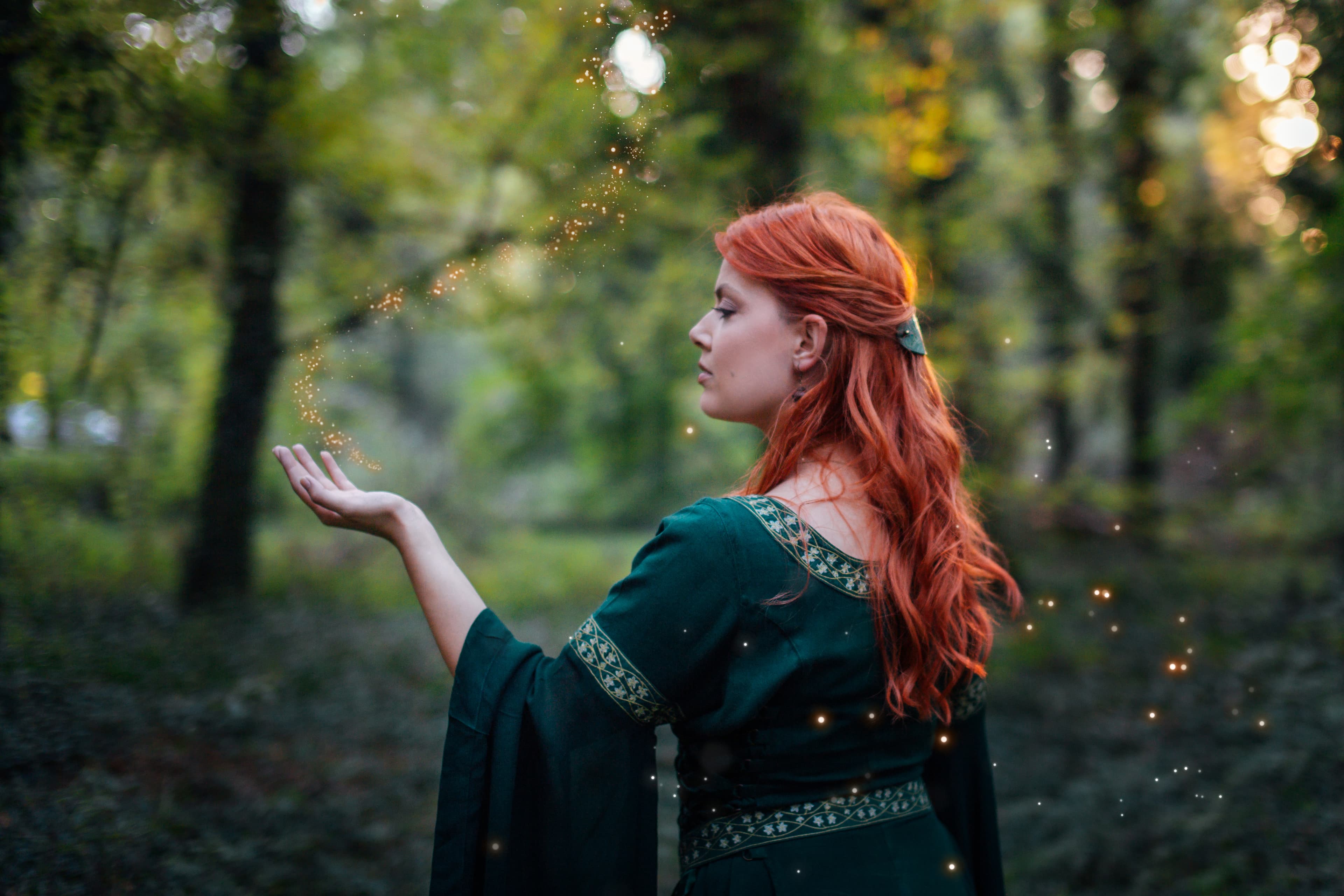
For my niche, which is fantasy, Nordic and Celtic-style singing, outdoor singing clips create an excellent vibe. This is especially true for singing in a forest, with light breeze messing with my hair naturally, and the grass and leaves silently rustling. It literally breathes life into the “performance”.
However, you cannot control the lighting like you can in the booth. And that is not necessarily a bad thing. I sit half in shade, half letting the sun caress my face. It creates a visual dynamic. I recorded videos during the golden hour, and also in the morning. For more atmospheric vibe, you can choose a cloudy day. And last but not least, you can always add a filter or other video effects in post-production. Even the basic features like exposure, contrast and shadows might do the trick.
Singing bloopers
This is highly Instagrammable and perhaps even more suited for TikTok. It should be fast-paced, with individual clips or 1-2 seconds each, with perhaps a funny on-screen caption or voiceover.
People go crazy about this type of content because it’s funny and it adds the much-desired human element to your story.
Vocal stacking
As a singer, being able to show how you stack layers of sound, and sing your own harmonies is a valuable skill, especially for social media. You can add a video overlay for each new harmony, which makes for a more dynamic video. It showcases your skill as a singer, and engages the audience with multiple layers of sound, some of which can be quite unexpected.
Rehearsals
As I said, people like seeing the process, in this case, witnessing the birth of a song all the way to the finished product. I like combining raw clips of rehearsals with the more polished recording of the same track. It adds continuity and tells a story.
Live gigs
This format is a staple social media content for any singer. Posting polished versions of a song is fine, but treating your followers to a clip or you singing live does wonders. The goal is to bring people to hear you sing live, so give them a little preview, so they know exactly what to expect.
Stories
I use stories mostly for engagement with questions and polls, especially on Instagram. It’s where my followers can actively engage with me anonymously, if they so prefer, and have a chance to express opinions they might be too shy to do otherwise.
I also use stories to test my reels ideas before I actually record them. Also, stories can be used to build anticipation for an upcoming gig or reel.
Carousels
This is my go-to format for Instagram carousels: a few stills and a video. I use them to tell a particular story, share my personal story, behind-the-scenes stills, and light educational content.
Honourable mentions
Even though I experiment more with content formats for Instagram, I repurpose that content for LinkedIn, YouTube and Reddit. Here’s how.
LinkedIn posts should not scream “see me, see me!”
You might think your singing content has no place on LinkedIn, and that’s where you are in the wrong. I repurposed my vocal stacking clip for LinkedIn by adopting a different angle. I talked about the skills needed to actually stack vocals and how to edit the vocals, rather than focusing on the actual performance. In other words, I went technical, rather that showing off.
I also use LinkedIn posts to send people to my website. I reword parts of my blog posts so they fit the LinkedIn post format, and then add the link to the actual blog post. It helps grow my website as traffic is sent its way, plus I stay active on LinkedIn.
Reddit is a goldmine
Reddit users are brutally honest, and less likely to upvote mediocre content. I strategically post my singing content to appropriate subreddits to get feedback on my content, and see what vibes with people the most. As you can see, I really go for being present everywhere with my Disunna brand, so as to give more signals to people and Google that I’m a real person.
YouTube shorts are great for reach
In my niche, chances are I could reach my target audience easier by posting YouTube shorts. Engagement may be lower, but I’ve seen more reach than on Instagram, and also a higher ratio of new subscribers for each new short.
And finally, I have a lot of fun doing all of this. I’ve learned a lot about videography, sound editing, lighting, and about social media. As I get better with time and practice, my brand will grow into something people will instantly recognize, and hopefully, want to hire because of the person behind it.